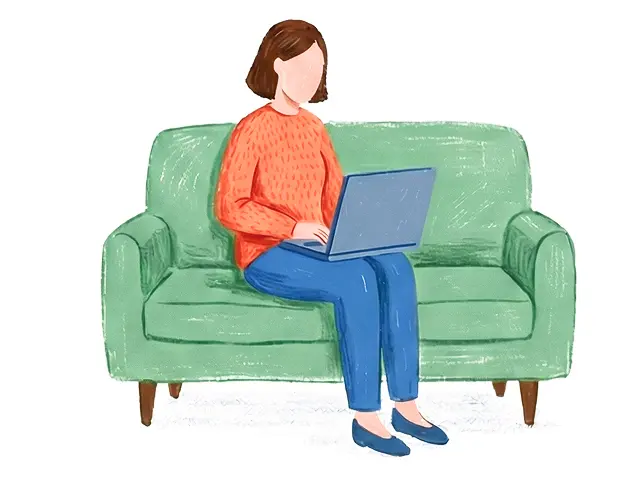
Which approaches suit online therapy?
Almost any therapeutic approach that suits a face-to-face session also suits an online meeting. The adaptation has less to do with the method and more with how the session is conducted: clarity, pace and special attention to cues that are harder to pick up through a screen.
- Cognitive behavioural therapy (CBT)
- Psychodynamic therapy
- Supportive, goal-focused therapy
- Support in times of stress and emergency
- Parent guidance at a distance
- Continuing therapy during a move or a stay abroad
What is online therapy?
Understanding online therapy
Online therapy is a full therapy session held over a secure video call, from wherever is convenient for you. The framework, session length and confidentiality are exactly the same as those of a session at the clinic.
Research in recent years shows that online therapy is similarly effective to face-to-face therapy for a wide range of difficulties, anxiety and depression above all. Its main advantage is accessibility: no travel, flexible hours and continuity even when life changes. What you need is mainly a quiet, private place and a reasonable internet connection.
What you can gain from online therapy
Remote therapy has become an accepted part of professional practice in Israel and around the world, and is also used within public mental health services. For people living in outlying areas, parents of young children, people with limited mobility and those who work unusual hours — it is sometimes the difference between getting therapy and not getting it at all.
Accessible from anywhere
No travel, parking or extra time needed — making therapy possible even for those who live far from the clinic or find it hard to get there.
Flexible timing
It’s easier to fit a session into a busy day, including early or late hours, without taking long hours off work.
Continuity of care
Therapy continues through periods of illness, bad weather, reserve duty, business trips or moving house — without breaking the continuity.
Privacy and comfort
Some people feel safer talking from the familiar surroundings of home, and open up more quickly.
Signs worth paying attention to
Who online therapy especially suits
- Difficulty getting to the clinic in person on a regular basis
- A schedule that doesn’t allow a fixed hour at a particular place
- Living outside the clinic’s area
- A clear preference for the home environment
- Parents of young children
- Students and people temporarily abroad
- People with limited mobility or illness
- Those who have already started therapy and moved house
Good to Know
Useful information before you begin.
How to Choose a Therapist
Clinical and Educational Psychologist — What’s the Difference?
When to Consider Therapy
Confidentiality in Therapy
The First Session — What to Expect
Psychodidactic Assessment — Who It Is For
ASD Assessment — How the Process Works
Frequently asked questions
Common questions
Is online therapy really effective?
Yes. Many studies have found effectiveness similar to face-to-face therapy for a range of difficulties, including anxiety, depression and stress. For most people the noticeable difference shrinks after two or three sessions.
Is it secure and confidential?
Sessions take place on an encrypted video platform, and confidentiality is the same as for a session at the clinic. On your side, it’s important to choose a place where you can’t be overheard, and to avoid recording the session. Sessions are not recorded.
What do I need technically?
A device with a camera and microphone — a computer, tablet or phone — a reasonable internet connection, and headphones to protect your privacy. A quiet place where you won’t be disturbed for about 50 minutes is recommended.
Who is it less suitable for?
Online therapy is less suitable in situations of immediate risk, in situations requiring close monitoring, and sometimes in work with young children who need physical presence and play. In such cases we’ll recommend a more suitable setting.
Can sessions at the clinic and online be combined?
Certainly, and it’s very common. Some sessions can be held at the clinic and some remotely, depending on what works for you at the time. Continuity of care is maintained either way.