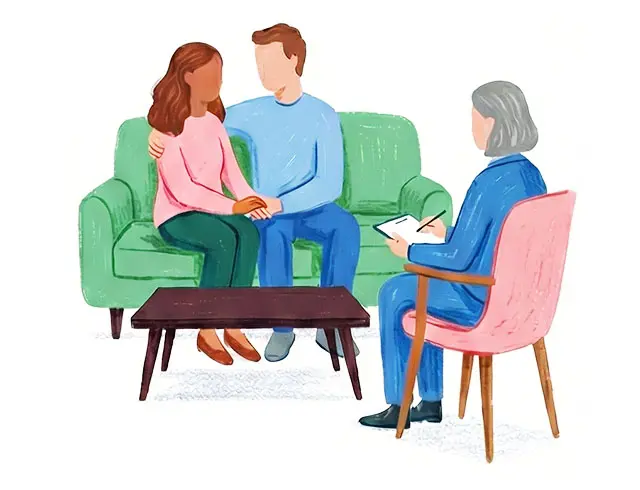
Which approaches are used in couples therapy?
Couples work focuses less on “who is right” and more on the cycle that keeps repeating between you. The approaches chosen are meant to stop that cycle, allow a conversation in which both partners feel heard, and rebuild the connection.
- Emotionally focused couples therapy (EFT)
- The Gottman approach to couple communication
- Systemic couples therapy
- Work on communication patterns
- Support through separation and co-parenting
- Couples therapy focused on trauma and infidelity
What is couples therapy?
Understanding couples therapy
Couples therapy is a shared space where things that have got stuck can be said in the presence of a neutral third party. The goal is not to decide who is right, but to understand what is happening between you — and to find another way to talk and grow closer.
In most couples who come to therapy the same cycle repeats: one asks for closeness or an answer, the other withdraws and becomes defensive, and the more one pushes, the further the other pulls away. The content changes — money, children, extended family, chores — but the movement is the same. The work begins by recognising this cycle, and only then turns to what lies beneath it: hurt, respect and needs that have gone unspoken.
What you can gain from couples therapy
Research on couples therapy shows a significant improvement in relationship satisfaction for a large proportion of couples. A key factor in success is timing: couples who seek help early, before years of bitterness have built up, achieve better results. It’s worth knowing that even when the process leads to separation, it helps you part respectfully and with less harm.
Conversations that don’t escalate
Recognising the moment a conversation gets out of hand, and being able to stop in time — so that a disagreement doesn’t turn into a fight that lasts for days.
Rebuilding trust
A structured way to deal with hurt or a breach of trust: first stabilisation, then exploration, and finally rebuilding a sense of safety in the relationship.
Closeness and intimacy
Renewing emotional and physical connection, and being able to talk openly about needs and expectations without shame or blame.
Decisions made with clarity
Clarity about what each of you wants — including the possibility of deciding to separate after careful thought rather than in the heat of the moment.
Signs worth paying attention to
When couples therapy can help
- The same argument keeps coming back without resolution
- Silence or distance has replaced conversation
- Feeling lonely within the relationship
- Constant criticism, contempt or defensiveness
- After infidelity or a breach of trust
- Around a major transition — a birth, a move, retirement
- When the children are exposed to the tension between you
- When you are considering separation and want to explore it fully
Good to Know
Useful information before you begin.
How to Choose a Therapist
Clinical and Educational Psychologist — What’s the Difference?
When to Consider Therapy
Confidentiality in Therapy
The First Session — What to Expect
Psychodidactic Assessment — Who It Is For
ASD Assessment — How the Process Works
Frequently asked questions
Common questions
Do both partners have to come?
It is strongly recommended that you both come, because the work is about what happens between you. That said, you can start even when only one partner reaches out: a change in how one partner moves often changes the whole dynamic.
What if we are already considering separation?
Couples therapy doesn’t have to end with staying together. The goal is to reach a clear decision instead of remaining in exhausting indecision. When the decision is to separate, the process helps you do so respectfully — and especially to protect the children.
Does the therapist take sides?
No. The therapist’s role is to keep a space in which both partners feel heard. At certain points you may feel the therapist is “siding” with one of you — this is part of the work, and it balances out over the course of the process.
How many sessions are needed?
Couples work tends to be more focused than individual therapy. Many couples notice a real change within a few months of weekly or fortnightly sessions. An acute crisis, such as infidelity, usually requires a longer process.
Are there individual sessions as well?
Yes. In many cases there is an individual session with each partner at the start, to hear each side separately. It’s important to be clear from the outset: what is said in an individual session is not passed on to the other partner without consent.