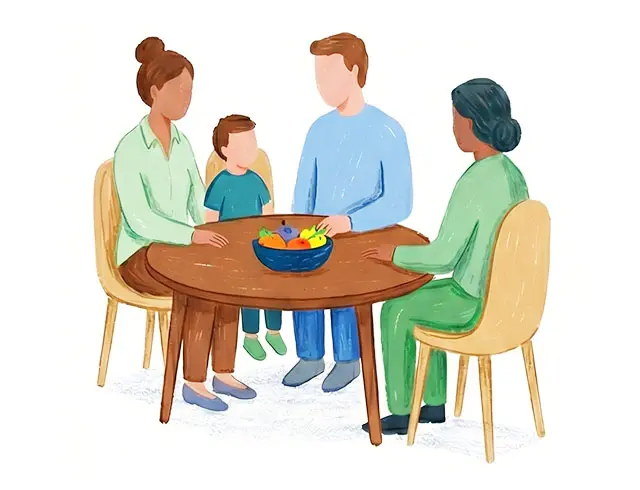
Which approaches are used in family therapy?
Family therapy looks at the family as a system: each person affects the others, so a change in one moves everyone. The approaches chosen are meant to change the dynamic between family members, not to “fix” one person.
- Systemic family therapy
- Structural family therapy
- Narrative therapy
- Parent Guidance
- Work with families in transition or crisis
- Parent–child dyadic therapy
What is family therapy?
Understanding family therapy
Family therapy is a meeting in which several family members are present together. It is suitable when the difficulty belongs not to one person but to what happens between you — recurring tensions, communication difficulties, or a crisis the whole family is facing.
Families often arrive with an “identified patient” — a child or family member who is seen as the problem. One of the first tasks of therapy is to widen the view: sometimes that person’s behaviour is the way the whole family expresses distress. When the view changes, the pressure on that person eases and everyone can work together. The work touches on roles, boundaries and alliances within the family.
What you can gain from family therapy
Family therapy is considered one of the most effective interventions for behavioural difficulties in children and adolescents, and for family crises such as divorce or illness. Its strength comes from the fact that change happens not only in the therapy room but at home itself, and that several people drive it at the same time.
More open communication
Being able to talk about sensitive subjects without the conversation blowing up, so that everyone — including the children — feels they have a place.
Clear boundaries
Redefining roles and boundaries: what is the parents’ responsibility, what is the children’s, and where the lines are.
Less tension at home
A real reduction in everyday tension, shouting and arguments that keep circling the same issues.
A united parental front
Agreement between the parents on a shared approach to upbringing, so that the children receive a consistent message rather than moving between two positions.
Signs worth paying attention to
When family therapy can help
- Frequent arguments that keep returning to the same issues
- A child or adolescent who has withdrawn or shut down
- Parents who disagree about boundaries
- A tense atmosphere felt throughout the home
- After divorce or separation
- When new family members join
- In times of illness, loss or crisis
- When difficulties return despite individual therapy
Good to Know
Useful information before you begin.
How to Choose a Therapist
Clinical and Educational Psychologist — What’s the Difference?
When to Consider Therapy
Confidentiality in Therapy
The First Session — What to Expect
Psychodidactic Assessment — Who It Is For
ASD Assessment — How the Process Works
Frequently asked questions
Common questions
Who should come to the session?
Who attends is decided according to need and changes over the course of the process. Sometimes the whole household comes, sometimes only the parents, and sometimes a parent with one child. In the introductory session we’ll decide together which combination will help most at this stage.
Do the children take part in every session?
Not necessarily. Children’s participation is considered according to their age and the topic. Some matters are best clarified between the parents alone, and there is no need to expose children to every conversation. Keeping the children out of the conflict is a guiding principle.
What if a family member refuses to come?
This happens quite often, especially with adolescents. You can start without them — a change in the behaviour of the rest of the family changes the system, and more than once someone who refused at first later joins of their own accord.
How is this different from parent guidance?
Parent guidance focuses on the parents and their tools, and the child is usually not present. Family therapy includes family members together and deals with the dynamic between them. Sometimes the two are combined in the same process.
How long does the process take?
Family processes tend to be relatively focused, and often span several months. Frequency is set according to need — weekly during a crisis, and more spaced out in a stabilisation phase.